Allocate recently hosted more than 150 CIOs, wealth advisors and fund managers in Austin at Converge by Allocate (formerly Allocate Alts Day). The new name reflects why the event exists: private wealth and private markets are converging, and both sides benefit from being in the same room.
Across the main stage and peer breakouts, conversations ranged from AI in buyout portfolios to investing in sports franchises. Below are our takeaways from the forum, layered with insights from industry research. Together, these themes show a wealth channel that’s maturing quickly, raising the bar for the advisors and managers who serve it.
Converge runs under the Chatham House Rule, so insights from panels and breakout sessions aren’t attributed to individual speakers or firms.
1. Private Markets Become a Client Differentiator
The wealth channel has become a fast-growing source of capital for private markets. Samir Kaji, Allocate's CEO and Co-Founder, opened the day by putting numbers to that trend. U.S. wealth advisor clients have about $2.2 trillion committed to alternatives, a figure that Cerulli Associates expects to nearly double over the next five years. The vehicles built for the wealth channel are growing as well: interval and tender offer funds reached over $300 billion as of June 2026, more than doubling 2023’s year-end total.
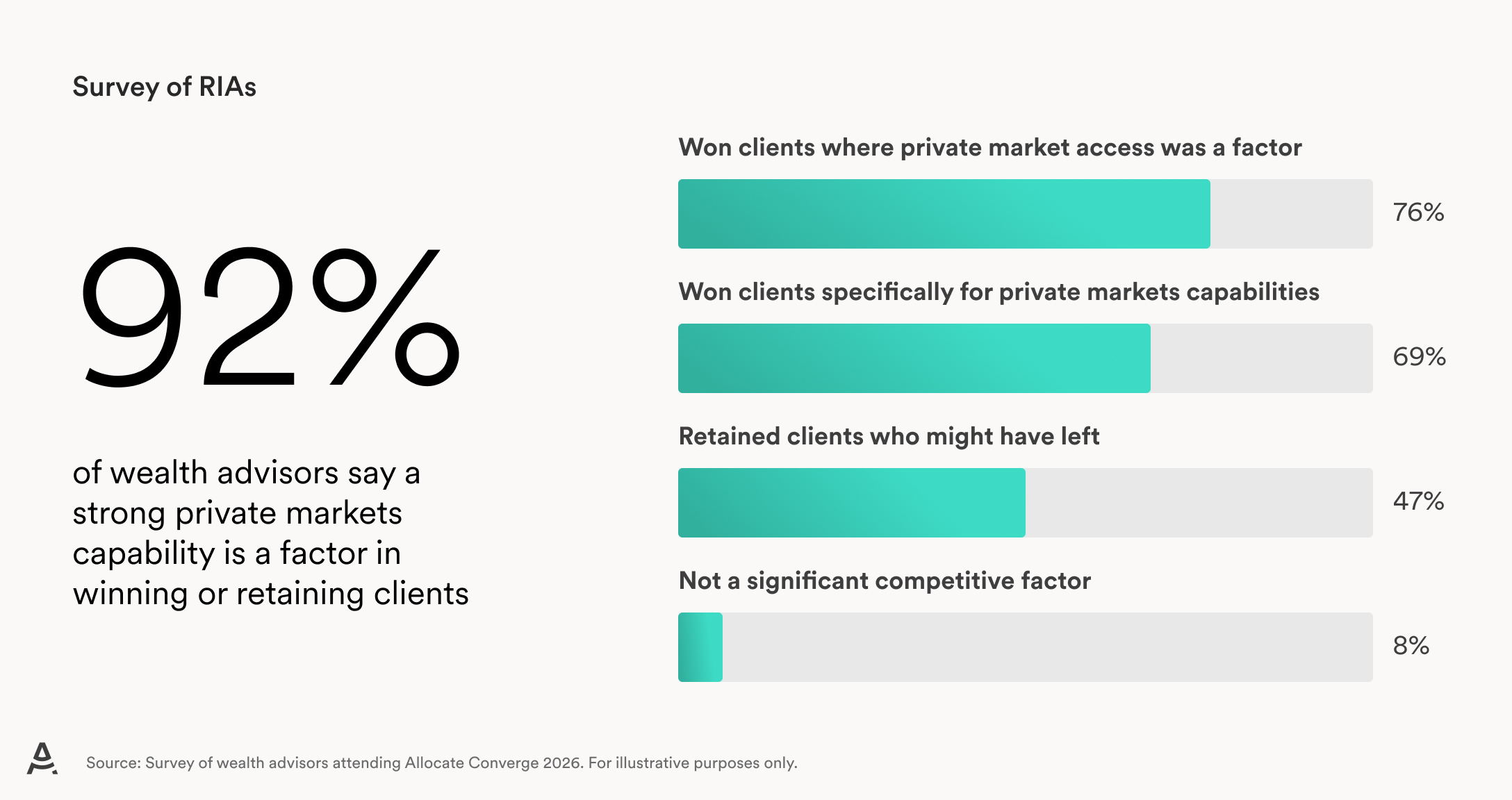
In a survey of advisors attending Converge, 92% said a strong private markets capability is a factor in winning or retaining clients. Many clients haven’t had the conversation yet: a 2026 investor survey from FTSE Russell found that nearly half of advised investors have never discussed private markets with their advisor.
For many firms, the biggest hurdle to offering private market investments is operational. Sourcing, underwriting, education, suitability, execution, custodian recognition, and reporting are still largely manual, which limits what teams can offer.
2. The Wealth Channel Survived Its First Stress Test
Private credit spent much of 2026 under a harsh spotlight, with headlines warning of a reckoning. It was also the asset class’s first real stress test since opening up to the wealth channel. Individual investors, alongside institutions, were exposed to private credit’s performance under pressure.
According to Stanger data, redemption requests for non-traded BDCs spiked to 12.4% of NAV in Q2. Despite the rush to the exits, one panelist noted that the operating metrics in their portfolio barely moved. Another investor with a sizable credit book said that credit quality hadn’t changed through June, and that there was no fundamental reason for the pullback.
Throughout this stress test, the vehicles built for the wealth channel largely worked as designed. Although some investors faced gated redemption requests, these gates helped prevent a disorderly sell-off. According to Evercore, GP-led private credit secondaries priced at an average of about 99% of fair market value in the first half of 2026, despite headlines about steeper discounts. The experience wasn’t painless, but it showed that the wealth channel can weather a period of disruption in private markets.
3. AI Is Rewriting Both Business Models and Underwriting
AI came up in nearly every session. Panelists focused on how the technology is transforming the companies in their portfolios, and how that shift is affecting investment underwriting.
Inside software portfolios, one investor estimated that AI could add 20–30 percentage points of margin, concentrated in the three largest cost centers: engineering, customer support, and sales. The open question is pricing. Now that buyers can do more in-house with AI, some are pushing back on the automatic annual price increases they used to accept at renewal.
As business models shift, so does the math behind valuing them. One panelist described underwriting an AI company at roughly 180 times run-rate revenue, a price that looked extreme by SaaS standards. Revenue grew so quickly that the multiple fell to about six times within a few quarters. Valuation habits built for linear SaaS growth can badly misjudge companies growing exponentially. Durability is harder to underwrite, though, since the same tools that let a company scale quickly can also help competitors catch up. For allocators, that puts a premium on managers who can judge which AI-led growth will last.
4. Liquidity Is Now Something Managers Have to Build
Panelists noted that the IPO window is open, but very few companies are walking through it. That leaves managers needing to create liquidity themselves, rather than relying on public markets. Across sessions, we heard several ways that managers are generating liquidity:
- Selling positions on the secondary market. The secondary market continues to grow as GPs seek alternatives to traditional exits.
- Establishing networks of buyers for niche assets. In sports, where buyers can be hard to find, one manager built a network of thousands of prospective investors to arrange exits directly.
- Using NAV lending carefully. Borrowing against a fund’s portfolio allows a manager to pull forward distributions, though the interest cost typically lowers total returns.
None of these strategies replaces a healthy IPO market. Even so, with fewer companies going public, managers are becoming more proactive about returning capital to LPs.
5. Selection Now Matters More Than Access
Wider access to private markets has been one of the defining stories of the last few years. At Converge, the discussion moved from access to selection. Outcomes are spreading out within asset classes, meaning that picking the right managers matters more than access alone.
Dispersion has been increasingly evident in private credit. Returns in direct lending cluster fairly tightly across managers, but specialty finance and other riskier strategies are showing greater variance. Venture capital is seeing a similar trend, with a widening gap between winners and losers.
In certain asset classes, barriers to entry remain. Owning a stake in a sports franchise requires league approval, and access typically runs through a small set of funds. As a whole, though, the question has shifted from whether investors can participate to whether they’re choosing the right investments.
Looking Ahead
Private wealth and private markets are moving closer together, and this year’s conversations showed how far that trend has come. The wealth channel has become a meaningful investor in private markets, has been through its first real stress test, and is now facing the harder questions of selection and liquidity. Those questions don’t have simple answers, but they’re easier to work through when both sides are in the same room.

MARKET COMMENTARY
Any opinions, assumptions, assessments, statements or the like (collectively, "Statements") regarding market condition, future events or which are forward-looking, including Statements about investment processes, investment objectives, goals or risk management techniques, constitute only the subjective views, beliefs, outlooks, forecasts, projections, estimations or intentions of Allocate Management, should not be relied on, are subject to change due to a variety of factors, including fluctuating market conditions and economic factors, and involve inherent risks and uncertainties, both general and specific, many of which cannot be predicted or quantified and are beyond Allocate's control. Allocate undertakes no responsibility or obligation to revise or update such Statements. Statements expressed herein may not be shared by all personnel of Allocate.